


Architecture exhibition. 16.05. - 30.06.2009. Berlin, Germany
7 Architects from 7 Hills
 |
 |
 |
7 ARCHITECTS FROM 7 HILLS
16.05. - 30.06.2009 // OPENING: 15.05.2009
The DAZ presents two exhibitions on contemporary architecture as well as urban tendencies in Istanbul:
BECOMING ISTANBUL and 7 ARCHITECTS FROM 7 HILLS.
Exhibition: 16.05. until 30.06.2009 in the DAZ Taut Saal
Tue to Fri 12am - 7pm, Sat + Sun 2 - 7pm. Free entrance.
7 ARCHITECTS FROM 7 HILLS will present the works of seven contemporary Turkish architects from Istanbul with photos, models and video presentations. The architects featured in the exhibition represent the leading figures in contemporary architecture in Turkey. While there are many talented architects working in Turkey today, the amount and quality of the work built by these designers set them apart. On the threshold of the third millennium, this group represents a new generation of architects with a commitment to Modernist values but they also aim to acquire their own international attitude.
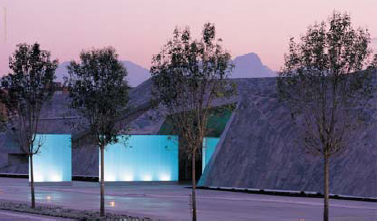
EMRE AROLAT’s works show a detailed level of refinement in form and material. Arolat’s contribution to Turkish Architecture is specifically tied to his sensitive adaptation of hard materials in stone and concrete and simple steel construction systems to large scale programs. His architecture balances the functional requirements required of these types of buildings with the limited possibilities in building technology and material. For non-residential buildings he does not deal with façades, instead he attempts to devise a multitude of geometric envelopes that surround, cover and embrace the building as a system.
CAN CINICI established his own independent practice initially in Ankara focusing on urban design and planning. He formed his unique pairing of simplified geometric forms that are synthesized into his own formal language. He coordinates it with a detailed understanding of material and texture that subsumes architectural values into an exercise of abstract geometry. Cinici’s adaptation into the architecture culture of Istanbul with its focus on representation and materials resulted in the transformation of his geometric rationalist approach. In work such as his Bursagaz Headquarters one can sense the latent yet robust underlying geometry of monolithic forms but with a more sensitive approach to how this geometry is expressed in materials.
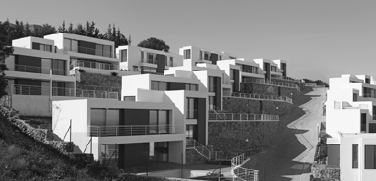
TEGET ARCHITECTURAL OFFICE was established by two architects, Mehmet Kutukcuoglu and Ertug Ucar, in Istanbul in the early 2000s. Teget has been involved substantially with the generation of form and abstract geometric structures in parallel with global tendencies in architecture. Their approach is more like ‘theme and variations’ combining the environmental approach and modernism with geometric rationalism. One can say that there is always something unidentifiable in the geometries of Teget’s work which is intuitive and personal.
SEVKI PEKIN is the most senior among the group of ‘Seven’ although he has never taken part in the mainstream of Turkish architectural culture. This may be partly due to his Viennese architectural education, partly due to his long practice in London. Pekin takes the precepts of open spatiality found in post WWII modern architecture and applies them to a delineation of space and massing that are pared downed extensions of local building practices. His highly tectonic architecture, focusing on basic elements of architecture, post and lintel, or mural, exists as neutral backgrounds for activity to take place, but also has a very strong relation to its context.
NEVZAT SAYIN authored many significant buildings that left their mark on the developments of architecture in Turkey in the late 1980’s to the present day. In the 1980’s Sayin exhibited the postmodern tendencies of that era and produced remarkable buildings that showed a loose connection to traditional forms that can be seen as post - modern such as his Shell Headquarters in Istanbul. During this brief period, he has always maintained a thorough going application of materials and building techniques that would be the hallmark of his work for many years to come. Sayin’s work in the 1990s came out of sensitive use of concrete and stone, and was the first to balance modern materials with archaism of traditional local techniques.
TABANLIOGLU ARCHITECTS of Murat Tabanlioglu and his wife and partner Melkan Gursel Tabanlioglu, have from its earliest years been closely associated with a type of robust architecture of monolithic orthogonal forms in concrete and steel and glass. Works in specifically concrete and simple steel forms starting from the 1990s represents some of the most original work of the office facilities. Tabanlioglu have their signature on many big projects in the 2000s including the largest scale mixed use urban projects and shopping centres that have made them into the largest architectural practice in Turkey. Their experimental engagements with environmentally friendly, energy efficient, greenhouse based projects in Istanbul will be generic examples in Turkey of the global trend in ecological buildings.
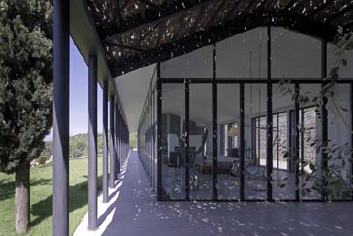
HAN TUMERTEKIN, one of the younger members of this group of architects, is by his own words ‘stylistically agnostic’. His forte for taking advantage of context and circumstances, shows a completely worked out architectonic and aesthetic sensibility indicative of a new architecture language to come. His commitment to minimal use of form brought him a distinguished recognition of receiving the Aga Khan Award for Architecture in 2004 for his B2 House. His Harvard professorship is perhaps the first for a non-expatriate Turk. Tümertekin has gained tremendous respect for his effort to remain pragmatic and obliterate opulence in his architecture. The exhibition is curated by World Architecture Community. WA Community is an initiative of Dr. Suha Ozkan, Hon FAIA, academician and former Secretary General of Aga Khan Award for Architecture, and Sefik Onat, former diplomat, project - and event manager. WA Community is the owner and operator of www.worldarchitecture.org, which is an independent global forum and extensive interactive database providing access to all the data available on the web internationally on architecture. The initiative also has created WA Community Awards which are given every three months to highlight and publish remarkable projects that might otherwise remain unnoticed by the international public but have the potential to inspire exciting questions about contemporary architectural discourse.
The exhibition at DAZ is supported by the Alfred Herrhausen Society, the international Forum of Deutsche Bank. It is under the patronage of the Mayor of Berlin and Senator for Urban Development, Ingeborg Junge-Reyer.
------
Text: Deutsches Architektur Zentrum (DAZ)
Photography:
> Project: Minicity Model Park, Antalya, Turkey, 2003
Architects: Emre Arolat Architects, Photo: Emre Arolat Architects
> Project: SM House, Ayvacik, Canakkale, Turkey, 2005
Architects: Han Tumertekin, Photo: Han Tumertekin/Cemal Enden
> Project: Novron Yalikavak Houses, Turkey, 2006
Architects: Teget Architectural Office, Photo: Teget Architectural Office/ Cemal Emden
Copyright 2007 - 2009 architeria.eu all rights reserved

