


Architecture exhibition. 16.05. - 30.06.2009. Berlin, Germany
PALAEONTOLOGY PAVILION
 |
 |
 |
 |
 |
 |
 |
 |
 |
FOLLOWING THE SILESAURUS- THE DESIGN OF THE PALAEONTOLOGICAL MUSEUM AND THE
EDUCATIONAL PARK IN KRASIEJOW.
Krasiejów- a small village placed in Ozimek commune in the province opolskie became in the 80s, the place
of unusual palaeontological excavated finds. The vertebrates’ remains, which were found on the area of
the loams’ quarry and the cement plant Górażdże, appeared to be pre-historical amphibians’ and reptiles’
fossils. Silesaurus opolensis -the oldest pre-dinosaur, a herbivorous, not large ( about 1 metre high), living
on the Krasiejów area, about 230 mln years B.C. is the greatest sensation. The unique, on the world
extent, discoveries become an opportunity for the village, for the commune and for the province promotion.
The first step in the direction was made. The national-wide architectural town-planning competition for
the masterplan of the post-quarries’ areas management was judged in 2003.
Here under is the opinion about the project rewarded with the first prize:
The work received 1st Prize for the complex and full solution of the problematical issues of the competition,
particularly for the idea of layers arrangement realized both in town- planning scale, architectural one and
the display draft, for the clear-sighted space conditions analysis, the area advantages exhibition, peculiarly
the excavation, as the unique space in the surrounding landscape and the existing post-quarries’ areas
management, the proper road and paths shaping around the excavation with terraces and view points,
creating clear, and defined in the landscape spacious accent with its transparent display of partial views
which can be seen by the travelers from the passing by train.
The rewarded work, as the only one which proposed to leave the quarry area in possibly untouchable,
natural condition, noticing its cultural and landscape values leaving the ground this what at the first sight
may seem to be the degradated space- a barren. The complex management of a post-quarry hutch,
the open space area and the museum- scientific team which consists of the palaeontological museum edifice,
the scientific- searching centre and the palaeontological pavilion which protects the most precious fossils.
In this way the main thesis have been formulated:
The leading plot of the idea of the palaeontological excavations management in Krasiejów is the landscape,
surface layer- structure both geologic and functional. The centre of the area the post-quarry excavation,
constitutes a huge crater in the ground which presents the growth of another geological stratum. Another
time coats are being shown.- eons, eras, periods. A delicate, diversified composition paradoxically
more visible by violent human interference. The specific spacious structure of Krasiejów and its area-
interlacing the ribbons of forests, the Mała Panwia windings, meadows, fields - are the ground
configurations, the precious entirety which we want to modify and respect as well. The noticed layer
-structure finds its continuity in all project scales - from the town- planning plan through post-quarry
area management to the museum architecture.
In December 2003 the author’s team received an order for the palaeontological pavilion project, which was
the first step of a scientific -searching centre. In a very short period of time a new conception was prepared
based on Principal’s general lines over- consulted with Professor Jerzy Dzik from the Polish Academy of
Science. The new conception must have taken into accounts, the restrictions resulted from the possessional
divisions and to manage the problem of sliding ground on the already existing tent, which is supposed to
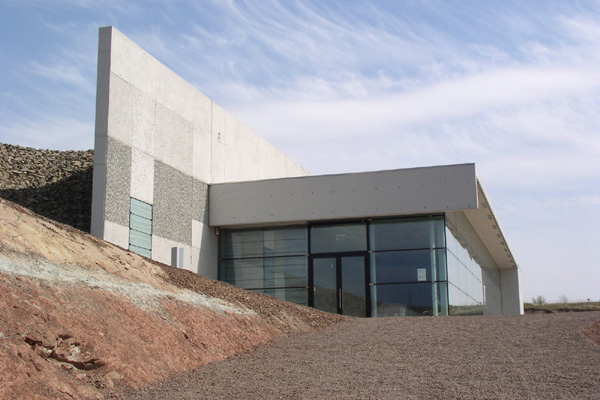
protect the slope’s excavations. The authors decided to introduce a new element- a huge reinforced concrete
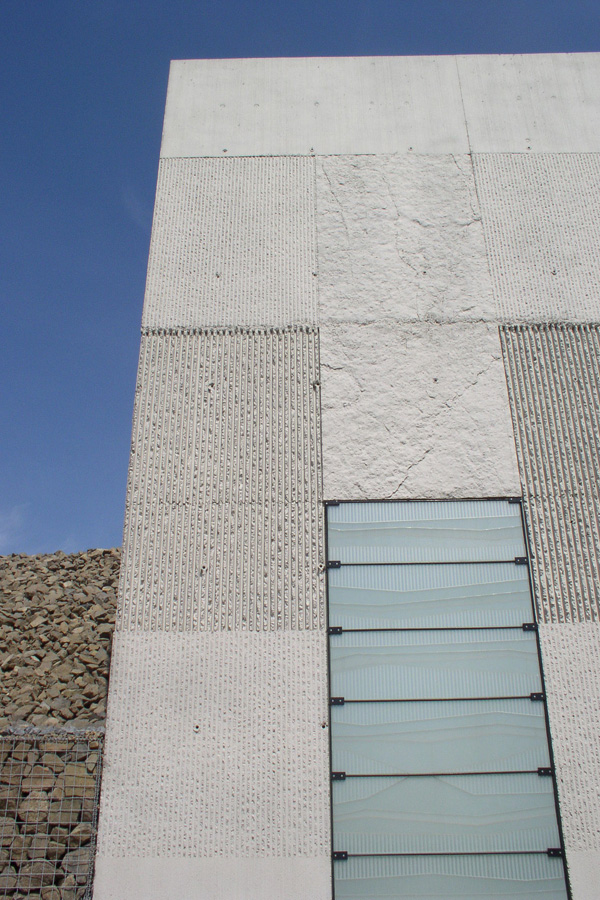
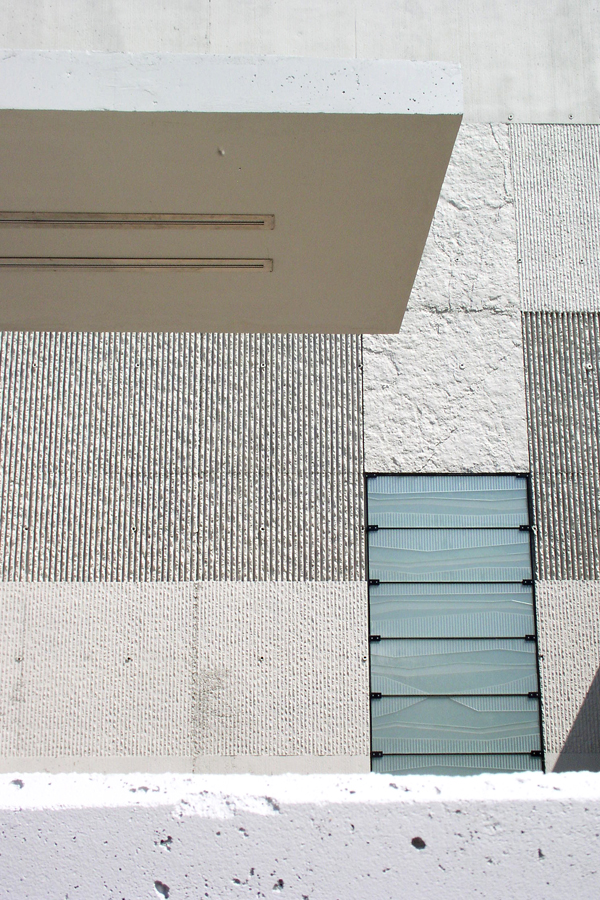
retaining wall with the texture reflecting the layer-structure what is the leading idea of the project.
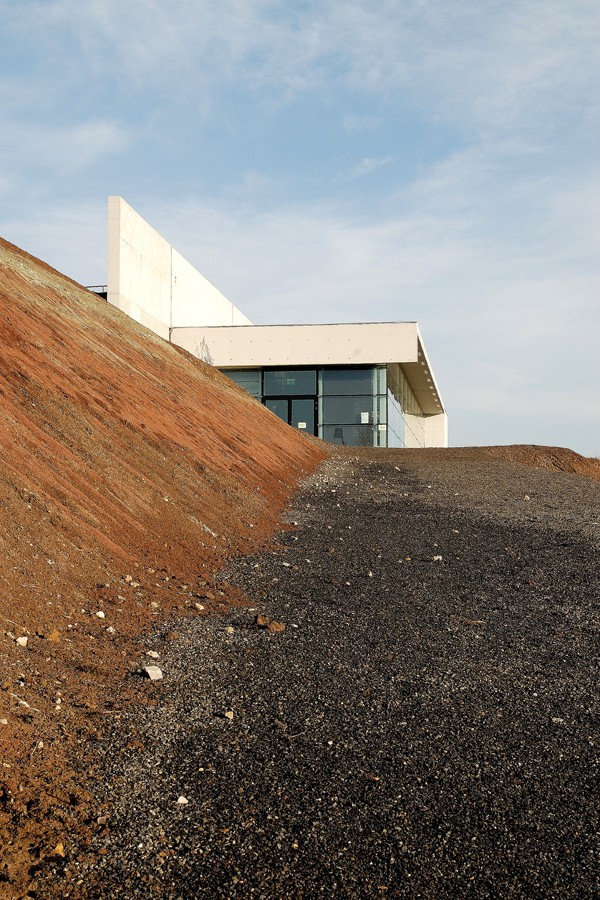
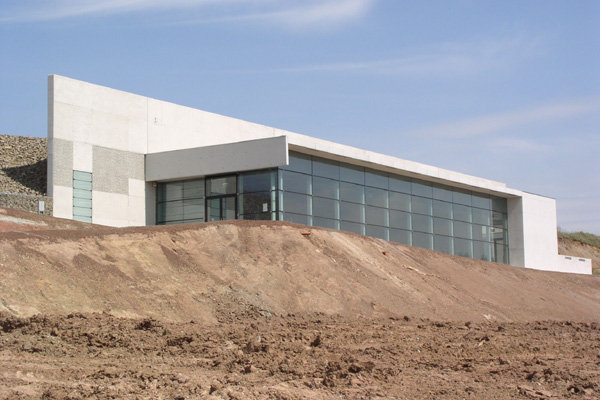
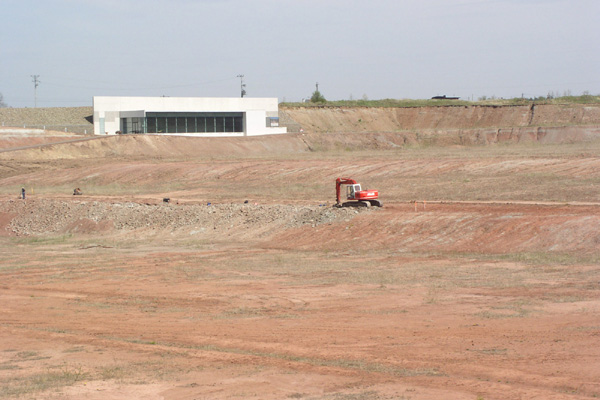
The reinforced concreted glass pavilion was placed on the natural, delicately formed and adjusted to the
sightseeing land. Here is the short description of the palaeontological pavilion, which was done in 2006.
The Palaeontological Pavilion was created with the idea of protecting and exhibiting the unique fossils of
Triassic reptiles and fossilized amphibians found in Krasiejów. It was created as the documentary post
predestinated to sightseeing. The pavilion centre and the retaining wall protecting the slope are the
integrated space composition. The retaining wall also constitutes the pavilion north wall and makes
the upper viewing terrace. Either the full walls and the retaining wall are made from reinforced concreted,
but the pavilion is finished with face concrete while the reinforced wall with texture concrete. Using different
concrete textures on the retaining wall in the layer-structure presents the idea of layer- structure of the
ground showing the Earth, which can be seen both in the pavilion and in the whole competitive idea of the
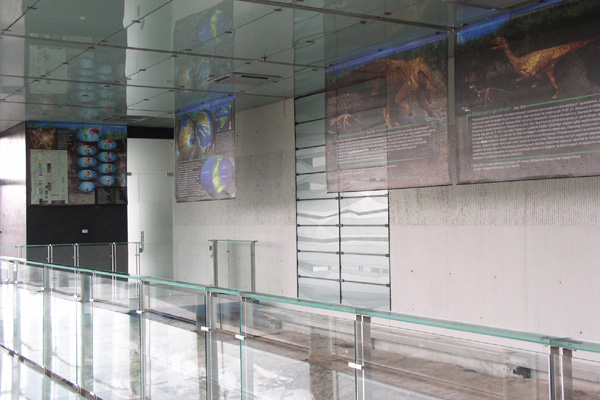
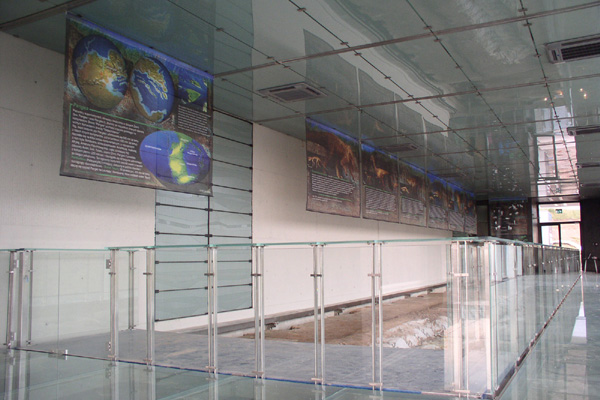
project being realized in the future by the museum- scientific unit. In the pavilion’s body there is contrast for
the heavy walls of face concrete which is constituted by a glazed front from the south and west side, what
enables the view both from the pavilion inside onto the post- quarry landscape and onto the display from
the outside. The glass floor on a steel grate fixed over the bony-bearing lets the visitors to move without
collisions over the fossils. The moving terrace for the palaeontologists’ was designed over the field of fossils
which will be explored for the next few years. The observation of the palaeontologists’ work will be the next
attraction for tourists.
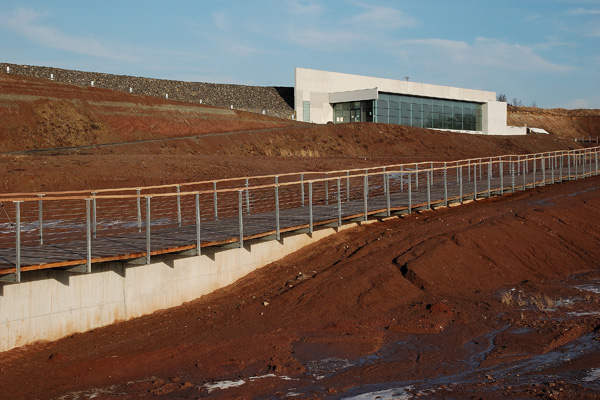
At present another element of the area management, like walking traps, educational paths, tourist
infrastructure are being realized and are based on previously designed masterplan. The spine of the
educational path is the basic element of the management. The path takes the advantages of the
existing landscape conditions - the BIOFORM, in a very attractive way and it acquaints the tourist
with the pre-historical flora and fauna.
The realization of the fields’ continuation display is planned along the designed trap-walking the part of the
architectural form which is floating and adhering to the surface. The above mentioned field due to be framed
by FORMS in order to restrain the unpredictable, rolling geometry of the BIOFORM. The display fields present
the arrangement of dinosaurs’ models which will be created by the suitable well- chosen green belt
miscellaneous surfaces (utilization of the soil natural advantages ) and the reconstruction of the extinct plants
characteristic for the particular period of time.
In its purposes, the Krasiejów’s area due to constitute unique on the world extent, educational park where
the scientific, educational, amusement and recreational aspects will join together in a harmony.
> Architects: Beata Goczol, Witold Goczol, Oskar Grabczewski, Maciej Grychowski, Katarzyna Chobot Goczolowie Architekci Studio Autorskie Zabrze ( PL ),OVO Grabczewscy Architekci Katowice (PL)
> Photographs: Courtesy authors.
Copyright 2007 - 2009 architeria.eu all rights reserved

