


Architecture exhibition. 16.05. - 30.06.2009. Berlin, Germany
1973: Sorry, Out of Gas
 |
 |
 |
ARCHITECTURE EXHIBITION
Canadian Centre for Architecture
Montreal, Canada
1973: Sorry, Out of Gas
07.11.2007 - 20.04.2008
The Canadian Centre for Architecture (CCA) presents 1973: Sorry, Out of Gas from 7 November 2007
to 20 April 2008. Organised by the CCA, this major exhibition and its accompanying catalogue are the first to
study the architectural innovation spurred by the 1973 oil crisis, when the value of oil increased exponentially
and triggered economic, political, and social upheaval across the world. Featuring over 350 objects including
architectural drawings, photographs, books and pamphlets, archival television footage, and historical
artefacts, the exhibition maps the global response to the shortage and its relevance to architecture today.
Sparked by the combination of reduced oil production and drastically increased prices, the oil crisis marked
the end of a period of constant growth in Western countries following the Second World War.Along with
social and economic adjustments such as energy-saving measures and reduced activity came the
understanding that unlimited development based on unrestricted oil at low prices was no longer feasible.
Taking its title from familiar signs at gas stations throughout North America during those years,
1973: Sorry, Out of Gas investigates how architecture and urbanism responded to this new reality.
In contrast to the era’s sense of austerity it was a time of significant developments and intense
experimentation in the field of architecture.
The research and innovations of thirty years ago are of particular relevance in the context of contemporary
concerns about diminishing energy resources. While influential at the time, much of the innovative work of
architects, engineers, and activist groups of the period was forgotten once financial markets and energy
distribution systems adjusted, and political focus diminished. Today, however, a new sense of urgency is
emerging,provoked by the reality of a deteriorating environment and a finite supply of fossil fuels. “It is of
vital importance to consider the radical yet, in many cases, little-known work from the 1970s as architects
today struggle to address similar issues,” said CCA Director and exhibition curator Mirko Zardini. “By providing
insight on the forerunners of many contemporary approaches to sustainable living, the exhibition aims to
increase public awareness and encourage contemporary research in the field.”
EXHIBITION CONTENTS
1973: Sorry, Out of Gas and its accompanying publication combine investigations from diverse fields,
including the development and applications of both active and passive solar technologies, experiments
with earth shelter building, improvements in insulation and construction materials, advances in wind
power technology, and the design of “integrated systems” to manage energy sources in larger contexts.
The exhibition captures the global social and political response to the oil crisis through footage of
impassioned television speeches, historic photographs recording lines at gas stations and streets emptied
of cars, and documentation of U.S. President Jimmy Carter’s 1979 installation of solar panels on the
White House roof – including one of the original panels (later removed by Carter’s successor Ronald Reagan).
The impact of the crisis on Western popular culture is represented by a selection of the era’s board games,
whose themes and titles capture the anxiety of a new lifestyle and reflect the profits of oil suppliers,
as well as promotional materials such as advertising campaigns and brochures.
Occupying the CCA’s main galleries, 1973: Sorry, Out of Gas is curated by Mirko Zardini, CCA Director and
Chief Curator, with Giovanna Borasi, CCA Curator of Contemporary Architecture. The exhibition is organised
along interrelated themes, including Austerity, which reflects the impact of the oil crisis on habits and lifestyle.
Passive Solar surveys efforts to adjust building design to take advantage of solar heat, while Active Solar
addresses the evolution and application of technologies to capture and convert the sun’s energy. Geopolitical
Consequences examines the reactions and initiatives in the political, commercial, and cultural realms.
Insulation and Underground Buildings presents attempts to conserve energy and integrate buildings
within their natural surroundings; and Wind maps the evolution from earlier wind turbine designs for rural
areas to new applications. Finally, Integrated Systems outlines projects that operate on scales of greater
complexity involving food production and larger societal groups. Rather than providing a complete
historical overview of the period’s research, the materials on view have been selected based on their
relevance to contemporary architectural concerns.
Among the exhibition highlights are individual projects by such architects as Steve Baer, Michael Jantzen,
Douglas Kelbaugh, Michael Reynolds, and Malcolm Wells, who designed and built innovative homes to gain
independence from existing energy distribution networks. Their little-known work broke new ground
by allowing alternative concepts of energy use to guide the formal and functional design of their structures.
Also featured are the contributions of key engineers George Löf, Maria Telkes, and others, whose
development of active solar power technology facilitated major architectural advances.
These autonomous projects in often remote locations were indicative of counter-culture attitudes that drove
much of the innovation of the time. Yet many parallel explorations addressed the question of energy
independence in urban environments. Among the most influential is a 1979 design by Oswald Mathias Ungers
created in response to a government-sponsored competition for a 400-home community in West Germany.
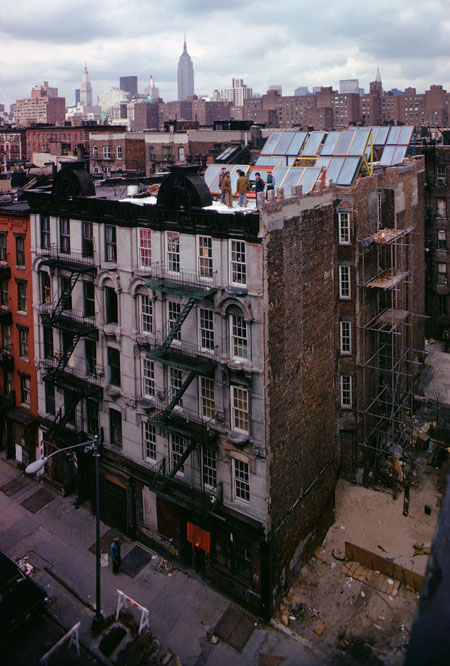
Another, more independent urban project is the 519 East 11th Street cooperative in New York City whose
tenant-owners installed solar panels and a wind turbine on the rooftop to provide energy for public spaces in
the building. This successful effort to gain independence from the urban power grid led to a legal battle with
the local supplier and prompted a lively public debate still relevant today.
In addition to individual architects and engineers, academic institutions were some of the most active
centres to develop new initiatives. Among the most ambitious and enduring is a research program
at the Massachusetts Institute of Technology (MIT), which has been studying the mechanical, chemical,
and electrical applications of solar energy since 1938. The shorter-lived Underground Space Center at
the University of Minnesota (1978-1995) presented its research through several influential publications
including Earth Sheltered Residential Design Manual.
A new typology of architectural publication evolved during this era: Do-It-Yourself books and guides
described not only how to construct a home, but how to integrate the necessary energy supply.
Among those featured in the exhibition are the instructive Practical Guide to Solar Homes, The Self-
Sufficient House, Michael Reynolds’ influential series Earthship, and Jay Swayze’s unusual Underground
Gardens and Homes.
The ideas and innovations brought together in 1973: Sorry, Out of Gas culminate with the projects of several
maverick groups including The New Alchemists, Montréal-based Ecol Operation, Farallones Institute, and
Integrated Life Support Systems Laboratories. Their efforts focused on expanding the scale from individual
housing to long-term sustainable communities. Described as “integrated systems,” their work
incorporates food production, housing, and waste-management. These projects offer the most complex
architectural responses to the energy crisis due to their focus on developing sustainability on an urban scale,
and form a vital foundation for contemporary planning of future ecological viability.
EXHIBITION DESIGN
Created by Montréal-based architect Gilles Saucier of Saucier + Perrotte Architectes, the exhibition design
employs an imposing, dark structure that links the different galleries and establishes a continuous flow among
the content. Visitors can choose different paths through the space, where thematic ideas are centered in
certain areas but the presentation of material reflects the mixing of concepts and research of the period.
The graphic design is by Zab Design & Typography of Winnipeg, Canada.
CATALOGUE
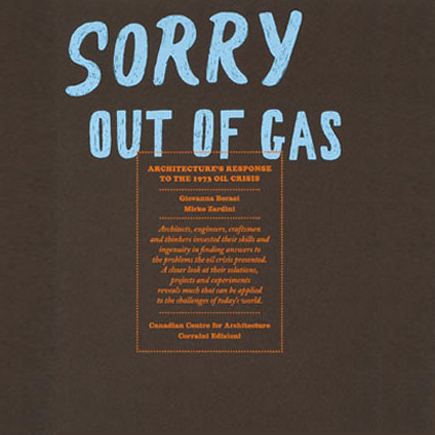
The accompanying catalogue, Sorry, Out of Gas, is a unique publishing project combining the diverse
materials assembled for the exhibition with a specifically commissioned children’s component by illustrator
Harriet Russell. In her 32-page story entitled “An Endangered Species,” Ms. Russell introduces the
exhibition’s subject to a broader audience of young readers. With her distinctive drawings and hand
-lettered text, Ms. Russell uses humour to describe the role of oil in daily life and to suggest alternatives
to this rapidly diminishing resource.
An essay by curator Mirko Zardini follows the introductory children’s component, while specific themes and
projects are highlighted throughout the book in short texts written by co-curator Giovanna Borasi along with
Adam Bobbette, Daria Der Kaloustian, and Pierre-Edouard Latouche.
Many of the architectural projects in the exhibition are represented through the photographs of Jon Naar,
who traveled extensively across North America to document buildings and their architects and engineers
in remote as well as urban contexts. His work disseminated their ideas through publications of the time,
and forms an essential contribution to the CCA catalogue and exhibition.
Co-published by the CCA and Corraini Edizioni, Mantua, and designed by Massimo Pitis with Bianca Baldacci,
Sorry, Out of Gas reproduces over 200 colour and black-and-white images on 232 pages.
The volume is available at the CCA Bookstore for $49.95 CAD.
PUBLIC PROGRAMS
Beginning in October, the CCA presents a series of public events in conjunction with the exhibition.
All programs take place at 7 pm on Thursday nights in the CCA’s Paul Desmarais Theatre and are free of charge.
Running on Empty is a series of contemporary and period documentary films that consider Western
society's addiction to oil and possible cures. Screenings include L’épopée de l’or noir, 2004 (4 October);
The Energy War, 1978 (11 October); The End of Suburbia: Oil Depletion and the Collapse of the American
Dream, 2004 (18 October); and A Crude Awakening: The Oil Crash, 2006 (1 November).
Yesterday Today investigates architectural ideas of the 1970s in light of contemporary environmental
issues through lectures by three of the central figures working to develop solutions during the time of
the energy crisis. Jon Naar presents Le Paradigme solaire /The Solar Paradigm (8 November);
Michael Reynolds, The Earthship Sustainable Housing Concept (15 November); and Witold Rybczynski,
Green Before Green (29 November).
EXHIBITION CURATORS
1973: Sorry, Out of Gas is the first exhibition curated by Mirko Zardini in his role as CCA Director and Chief
Curator, which he assumed in November 2005. As Visiting curator, Mr. Zardini previously curated the CCA
exhibitions Sense of the City (2005) and Out of the Box: Price, Rossi, Stirling + Matta-Clark (2004).
His research, writings, exhibitions, and architectural projects engage contemporary architecture, its
transformations, and its relationship with the city and landscape. A former editor of Casabella magazine and
Lotus International, Mr. Zardini also served on the editorial board of Domus magazine.
He has taught at prestigious architectural schools, including the Swiss Federal Polytechnic University in
Zurich, Harvard University, and Princeton University.
CCA Curator of Contemporary Architecture since 2005, Giovanna Borasi curated the exhibition Environment:
Approaches for Tomorrow (2006) on the work of Gilles Clément and Philippe Rahm. Before joining the CCA,
she co-curated House Sweet Home, Different Ways to Live, Spazio Ventisette, Milan (2000), and collaborated
on several exhibitions including Asphalt, The Character of Cities at the Milan Triennale with Mirko Zardini (2003).
Ms. Borasi was an editor and writer for Lotus International and Navigator.
She served as Assistant Editor for the book series Quaderni di Lotus; and was member of the editorial staff
of the graphic design magazine Lettera, a supplement to the architectural magazine Abitare.
ABOUT THE CCA
1973: Sorry, Out of Gas is the third in a series of thematic exhibitions organised by the CCA to explore
contemporary issues in architecture with a specific focus on urban, social, and environmental concerns.
It follows Environment: Approaches for Tomorrow (2006) and Sense of the City (2005), the groundbreaking
exhibition dedicated to the sensory dimensions of urban life that have traditionally been ignored or repressed.
The CCA is an international research centre and museum founded in 1979 on the conviction that architecture
is a public concern. Based on its extensive collections, the CCA is a leading voice in advancing knowledge,
promoting public understanding, and widening thought and debate on the art of architecture, its history,
theory, practice, and role in society today.
FUNDING
The CCA thanks Hydro-Québec and RBC Financial Group for their generous support of the exhibition.
The CCA gratefully acknowledges the generous support of the Ministčre de la Culture et des Communications
du Québec, the Canada Council for the Arts, the Department of Canadian Heritage,
and the Conseil des arts de Montréal.
-----------
CREDITS:
Text: Canadian Centre for Architecture
Photographs by:
No. 01
Frontcover of the exhibition catalogue Sorry, Out of Gas
© Centre Canadien d'Architecture/Canadian Centre for Architecture, Montréal.
No. 02
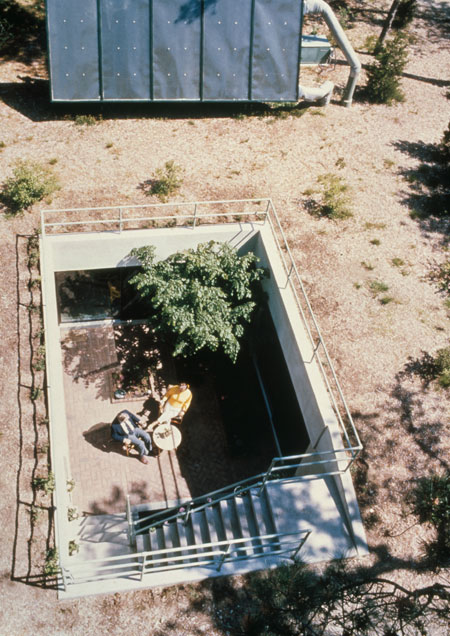
John E. Barnard Jr., architect. Ecology House, Osterville, Massachusetts, 1973.
View into courtyard with solar panel.
Photograph © Jack Lane
No. 03
Solar collectors installed on roof top at 519 East 11th Street, NYC, ca. 1976.
Photograph © Jon Naar, 1976/ 2007
Copyright 2007 - 2009 architeria.eu all rights reserved

