


Architecture exhibition. 16.05. - 30.06.2009. Berlin, Germany
OLD MARKET SQUARE
 |
 |
 |
 |
 |
 |
Photography: James Newton, Dom Henry, Dominik Bueckers
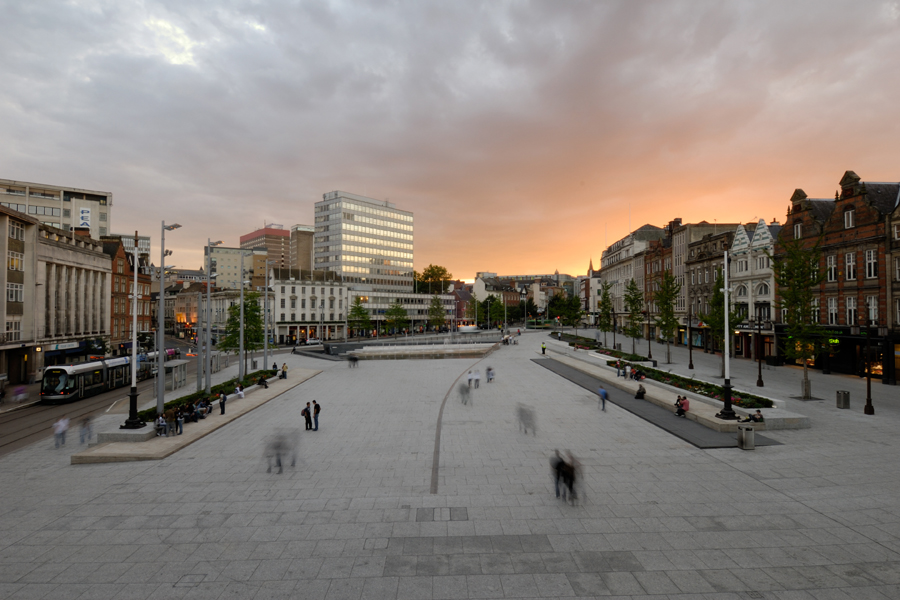
OLD MARKET SQUARE, NOTTINGHAM – ‘The Guardian of the City’
As the city’s heart it was vital that the renewed Old Market Square remained sensitive to the character
of the city and its inhabitants. One of the largest public squares in the UK, Old Market Square is the ‘face’
that Nottingham presents to the world and the new scheme should reflect the distinctive qualities of the
local area and community.
The vibrant and innovative design of the new square aims to fuse the past, present and future, incorporating
some of the historic elements of the original Cecil Howitt design alongside contemporary features that echo
the historical uses of the square. Old Market Square has been recreated as a space which will capture
the essence of the city without attempting to define it.
Memory and Culture
Angel Row marks the former location of an inn at the entrance to the medieval town of Nottingham and its
market square. An inn with the title of the ‘Angel’ identified the square as a safe haven for travellers –
a place where visitors could rest and gather strength for future transactions or journeys.
Old Market square has a huge impact, especially since access to this remarkable public space is via
narrow, twisting routes - the legacy of the Medieval street plan. Arriving in the square, the visitor has
a strong sense of space and welcome - the square is the city’s guardian angel, a safe haven, a place
to regain energy, wait for and meet friends, a place to be diverted momentarily from daily routines,
an urban theatrical space for Nottingham’s calendar of cultural and civic events.
A map of the town from 1610 shows a dynamic line entering Old Market Square from Chapel Bar
and the Derby Road, a feature that led visitors into the town’s heart and the space that the people
of Nottingham have historically depended on for their prosperity. The new scheme reintroduces a more
level surface into the square that allows the reintroduction of market stalls. Specialist markets will create
a focus selling books, crafts, and farmers’ produce. To take account of changing lifestyles, they can operate
into the early evening when people leave work for home, or while waiting to visit the cinema or theatre.
The dynamic line we have interpreted as a water channel that acts as a focus and leads one to a spectacular
water feature at the heart of the square. As Nottingham is situated on a hill, a system of pumps were
required in the 16th century to fill reservoirs to the northwest, and these fed channels that delivered fresh
water to the town’s inhabitants.
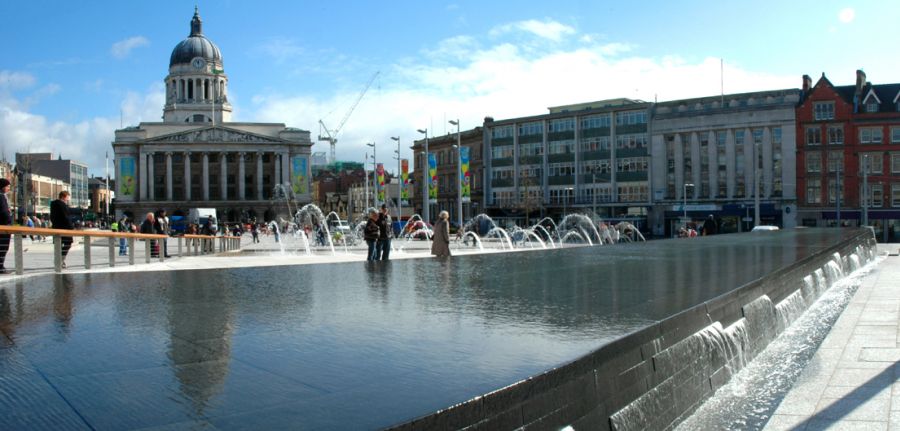
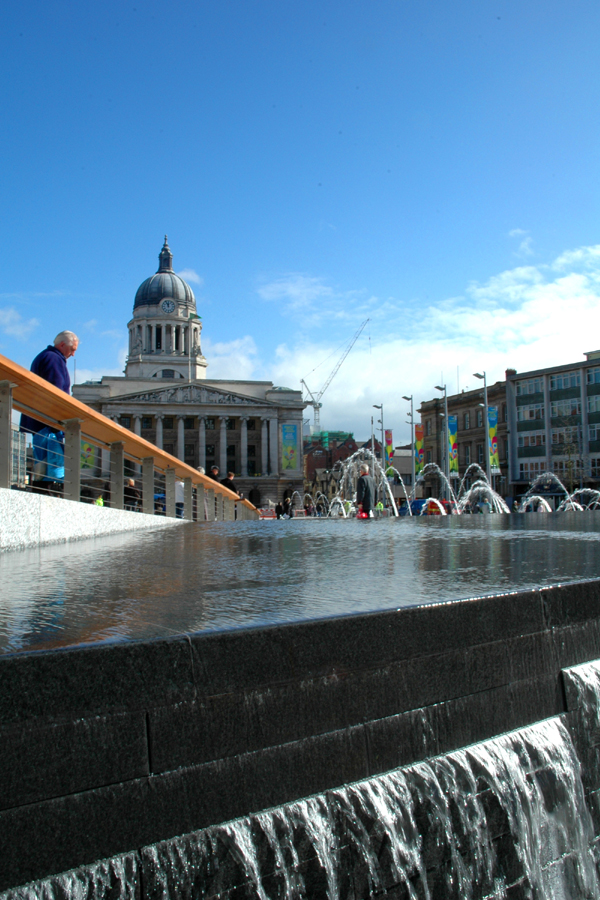
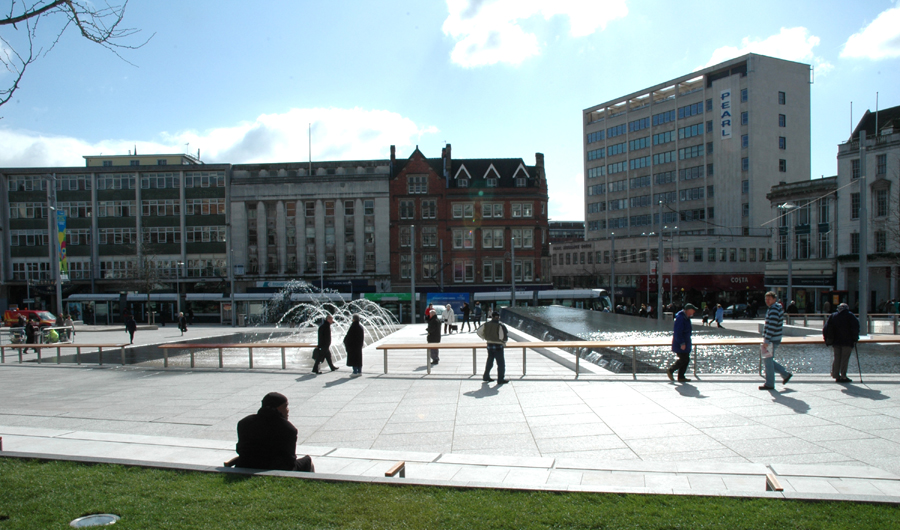
Our contemporary interpretation of this historic system is a series of three water terraces that change
character as water passes down the slope of the square’s west side. Visitors can sit on bench steps
amongst water or under the dappled light below a canopy of trees with a balcony view watching activities
unfold within the main body of the square.
The water terraces offer an alternative and as spectacular a focus as the Council House that currently
dominates the square’s east side. Our aim is to provide a flexible space that can change character,
from day to night, from season to season and as varying events require. The square will not only appear
active and safe when empty but also spacious and calm when busy.
Urban Connections
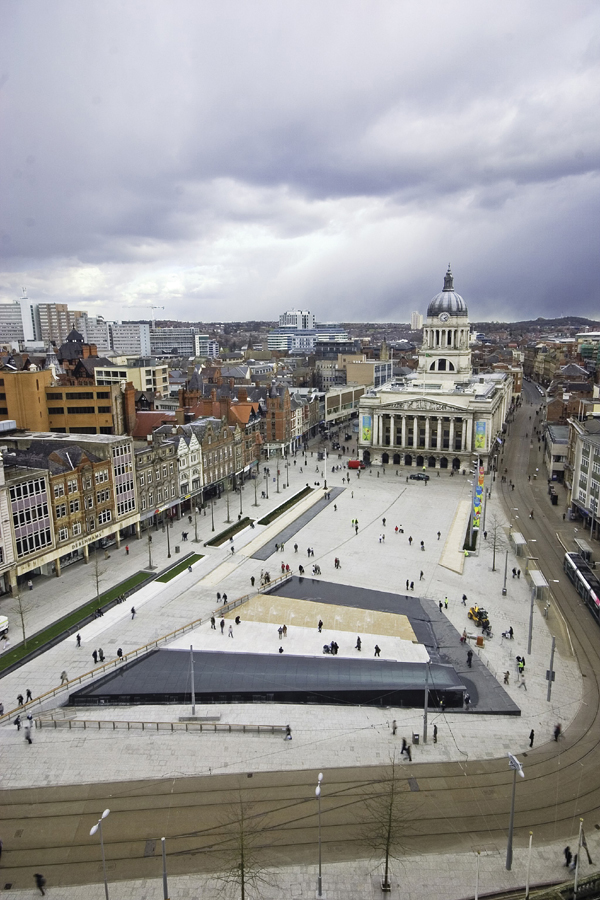
Two routes; one from Exchange Walk, Cheapside to the Council House, the other between Smithy Row
and Friar Lane to Nottingham Castle, create diagonal routes across the square. By reconnecting the square
with its surroundings the flow of the city through the space is restored. These new east-west routes
greatly improve access to specialist markets and popular events in the centre of the square.
The removal of obstructions such as ramped level changes, steps and balustrades, encourages a greater
flexibility in the arrangement of events and enables a better choreography of movement in and around
the square. The diagonal routes leave four spaces for rest and spectacle, the water terraces, the seating
steps, the market place and the tram stop.
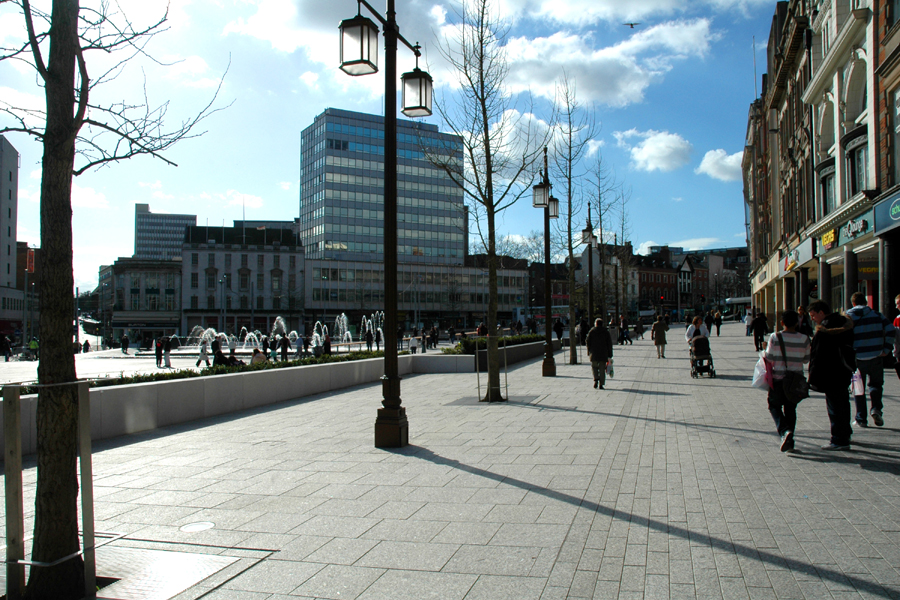
Long Row with its elevated view over the square and sunny position has been transformed into a terrace
for cafés and restaurants and a tree lined avenue of Gingko trees along which pedestrians promenade
and window-shop. Immediately to the south of this route, in the sun, a series of broad elevated seating
steps define the northern edge of the square, adjusting the level to create the flat plane on which
the Council House sits and from which the market can operate.
With safety in mind, we have used the square’s natural topography to create an easily observed dished
surface at its centre. This enables the whole central space to be easily observed both on entry and as
one walks around its perimeter. A completely redesigned lighting system means that the diagonal routes
through the centre of the space can be traversed easily at night.
Community
As a public space the square will provide amenities to the local population - a space to meet, promenade
and to host community events. However these cultural / social activities and recreational needs must be
balanced with the requirements for public circulation. Our aim has been to enhance links across the square
to connect the various districts of the city, but also bring the communities of those districts, both young
and old, to each other at the city’s heart.
Layers of Use
Because space is a rare luxury in our cities, the same space needs to accommodate different layers
of meaning, being simultaneously tranquil and energetic. Any public space must strive to be “both empty
when active and active when empty”. The new design complements the Square’s natural topography
and orientation, adapting easily to changing needs and events.
Looking at the path of light and shade across the square during the course of a day, it is clear that
the north side receives sunlight for most of the day except in winter, so in this area we have placed a band
of informal seating steps. The water feature still receives partial sun into the afternoon during the summer,
while the shade cast by the tower block to the west creates shadow in which the effects of the water
are clearly visible.
The terraced water feature acts during the day as the Square’s focal point, a performing, active feature.
When the market occupies the centre of the space the water terraces remain an alternative focus around
which people can sit. For civic events taking place in front of the Council House, the water can be
switched off and the terraces transformed into an amphitheatre; equally, the orientation of the square
can be reversed so that the water terraces become the stage and the market place becomes the audience
seating area.
Materials and Surface
The materials used for Old Market Square have been designed and selected to be sympathetic to their
context, robust enough to stand the test of time yet sufficiently distinctive to impart a sense of the unique
character of the place. The space is designed to be accessible to all – free of steep ramps and balustrades
but nonetheless mindful of public safety.
The central market square is composed of a large light coloured surface of slip resistant granite
that compliments the Portland stone of the Council House. It is accessible to vehicles for staging events,
setting up markets and creating the props for performances. Surrounding the central space, the seating
and water terraces are fashioned in white, beige and black coloured granites to reflect the range of stone
used in the surrounding building facades.
The Water Terraces
Water enters the terraces from a large black granite reflecting pool which overflows and enters two stepped
rills on its long sides and creates a dramatic waterfall on its short side facing Angel Row. Sitting on the top
terrace, the visitor is surrounded by water; from this level a second tier of water jets emerge from a slot
between the white and beige granite, before cascading onto a final water scrim surface of black granite
at market level.
Plants and Trees
To create intimacy, lines of plants create a layer of separation from the activity of Long Row and
the tram stop. Planters lined with a box hedge are filled with purple, silver, white and orange flowering
bulbs, perennials and shrubs that provide a living frame to the square, changing constantly in accordance
with the season.
A formal line of trees has been planted along Long Row to reinforce its status as a promenade that links
Chapel Bar and the western edge of the city with the shopping districts to the east. The trees we have used
for this purpose are Ginkgo biloba, which have a bold angular form, distinctive, bright green fan-shaped
leaves which turn bright yellow in autumn. On South Parade leading into Angel Row we have created
an avenue of Quercus palustris (Pin Oak) whose leaves turn bright red / brown in autumn reflecting
the brick facades of many of the square’s 19th-century buildings.
Gustafson Porter
February 2007
OLD MARKET SQUARE, NOTTINGHAM – ‘The Guardian of the City’
As the city’s heart it was vital that the renewed Old Market Square remained sensitive to the character
of the city and its inhabitants. One of the largest public squares in the UK, Old Market Square is the ‘face’
that Nottingham presents to the world and the new scheme should reflect the distinctive qualities of the
local area and community.
The vibrant and innovative design of the new square aims to fuse the past, present and future, incorporating
some of the historic elements of the original Cecil Howitt design alongside contemporary features that echo
the historical uses of the square. Old Market Square has been recreated as a space which will capture
the essence of the city without attempting to define it.
Memory and Culture
Angel Row marks the former location of an inn at the entrance to the medieval town of Nottingham and its
market square. An inn with the title of the ‘Angel’ identified the square as a safe haven for travellers –
a place where visitors could rest and gather strength for future transactions or journeys.
Old Market square has a huge impact, especially since access to this remarkable public space is via
narrow, twisting routes - the legacy of the Medieval street plan. Arriving in the square, the visitor has
a strong sense of space and welcome - the square is the city’s guardian angel, a safe haven, a place
to regain energy, wait for and meet friends, a place to be diverted momentarily from daily routines,
an urban theatrical space for Nottingham’s calendar of cultural and civic events.
A map of the town from 1610 shows a dynamic line entering Old Market Square from Chapel Bar
and the Derby Road, a feature that led visitors into the town’s heart and the space that the people
of Nottingham have historically depended on for their prosperity. The new scheme reintroduces a more
level surface into the square that allows the reintroduction of market stalls. Specialist markets will create
a focus selling books, crafts, and farmers’ produce. To take account of changing lifestyles, they can operate
into the early evening when people leave work for home, or while waiting to visit the cinema or theatre.
The dynamic line we have interpreted as a water channel that acts as a focus and leads one to a spectacular
water feature at the heart of the square. As Nottingham is situated on a hill, a system of pumps were
required in the 16th century to fill reservoirs to the northwest, and these fed channels that delivered fresh
water to the town’s inhabitants.
Our contemporary interpretation of this historic system is a series of three water terraces that change
character as water passes down the slope of the square’s west side. Visitors can sit on bench steps
amongst water or under the dappled light below a canopy of trees with a balcony view watching activities
unfold within the main body of the square.
The water terraces offer an alternative and as spectacular a focus as the Council House that currently
dominates the square’s east side. Our aim is to provide a flexible space that can change character,
from day to night, from season to season and as varying events require. The square will not only appear
active and safe when empty but also spacious and calm when busy.
Urban Connections
Two routes; one from Exchange Walk, Cheapside to the Council House, the other between Smithy Row
and Friar Lane to Nottingham Castle, create diagonal routes across the square. By reconnecting the square
with its surroundings the flow of the city through the space is restored. These new east-west routes
greatly improve access to specialist markets and popular events in the centre of the square.
The removal of obstructions such as ramped level changes, steps and balustrades, encourages a greater
flexibility in the arrangement of events and enables a better choreography of movement in and around
the square. The diagonal routes leave four spaces for rest and spectacle, the water terraces, the seating
steps, the market place and the tram stop.
Long Row with its elevated view over the square and sunny position has been transformed into a terrace
for cafés and restaurants and a tree lined avenue of Gingko trees along which pedestrians promenade
and window-shop. Immediately to the south of this route, in the sun, a series of broad elevated seating
steps define the northern edge of the square, adjusting the level to create the flat plane on which
the Council House sits and from which the market can operate.
With safety in mind, we have used the square’s natural topography to create an easily observed dished
surface at its centre. This enables the whole central space to be easily observed both on entry and as
one walks around its perimeter. A completely redesigned lighting system means that the diagonal routes
through the centre of the space can be traversed easily at night.
Community
As a public space the square will provide amenities to the local population - a space to meet, promenade
and to host community events. However these cultural / social activities and recreational needs must be
balanced with the requirements for public circulation. Our aim has been to enhance links across the square
to connect the various districts of the city, but also bring the communities of those districts, both young
and old, to each other at the city’s heart.
Layers of Use
Because space is a rare luxury in our cities, the same space needs to accommodate different layers
of meaning, being simultaneously tranquil and energetic. Any public space must strive to be “both empty
when active and active when empty”. The new design complements the Square’s natural topography
and orientation, adapting easily to changing needs and events.
Looking at the path of light and shade across the square during the course of a day, it is clear that
the north side receives sunlight for most of the day except in winter, so in this area we have placed a band
of informal seating steps. The water feature still receives partial sun into the afternoon during the summer,
while the shade cast by the tower block to the west creates shadow in which the effects of the water
are clearly visible.
The terraced water feature acts during the day as the Square’s focal point, a performing, active feature.
When the market occupies the centre of the space the water terraces remain an alternative focus around
which people can sit. For civic events taking place in front of the Council House, the water can be
switched off and the terraces transformed into an amphitheatre; equally, the orientation of the square
can be reversed so that the water terraces become the stage and the market place becomes the audience
seating area.
Materials and Surface
The materials used for Old Market Square have been designed and selected to be sympathetic to their
context, robust enough to stand the test of time yet sufficiently distinctive to impart a sense of the unique
character of the place. The space is designed to be accessible to all – free of steep ramps and balustrades
but nonetheless mindful of public safety.
The central market square is composed of a large light coloured surface of slip resistant granite
that compliments the Portland stone of the Council House. It is accessible to vehicles for staging events,
setting up markets and creating the props for performances. Surrounding the central space, the seating
and water terraces are fashioned in white, beige and black coloured granites to reflect the range of stone
used in the surrounding building facades.
The Water Terraces
Water enters the terraces from a large black granite reflecting pool which overflows and enters two stepped
rills on its long sides and creates a dramatic waterfall on its short side facing Angel Row. Sitting on the top
terrace, the visitor is surrounded by water; from this level a second tier of water jets emerge from a slot
between the white and beige granite, before cascading onto a final water scrim surface of black granite
at market level.
Plants and Trees
To create intimacy, lines of plants create a layer of separation from the activity of Long Row and
the tram stop. Planters lined with a box hedge are filled with purple, silver, white and orange flowering
bulbs, perennials and shrubs that provide a living frame to the square, changing constantly in accordance
with the season.
A formal line of trees has been planted along Long Row to reinforce its status as a promenade that links
Chapel Bar and the western edge of the city with the shopping districts to the east. The trees we have used
for this purpose are Ginkgo biloba, which have a bold angular form, distinctive, bright green fan-shaped
leaves which turn bright yellow in autumn. On South Parade leading into Angel Row we have created
an avenue of Quercus palustris (Pin Oak) whose leaves turn bright red / brown in autumn reflecting
the brick facades of many of the square’s 19th-century buildings.
Gustafson Porter
February 2007
Copyright 2007 - 2009 architeria.eu all rights reserved

